
How to Identify Real Salesforce Skill Gaps Before Your Next Project
11 Jun 2026
Table of Contents
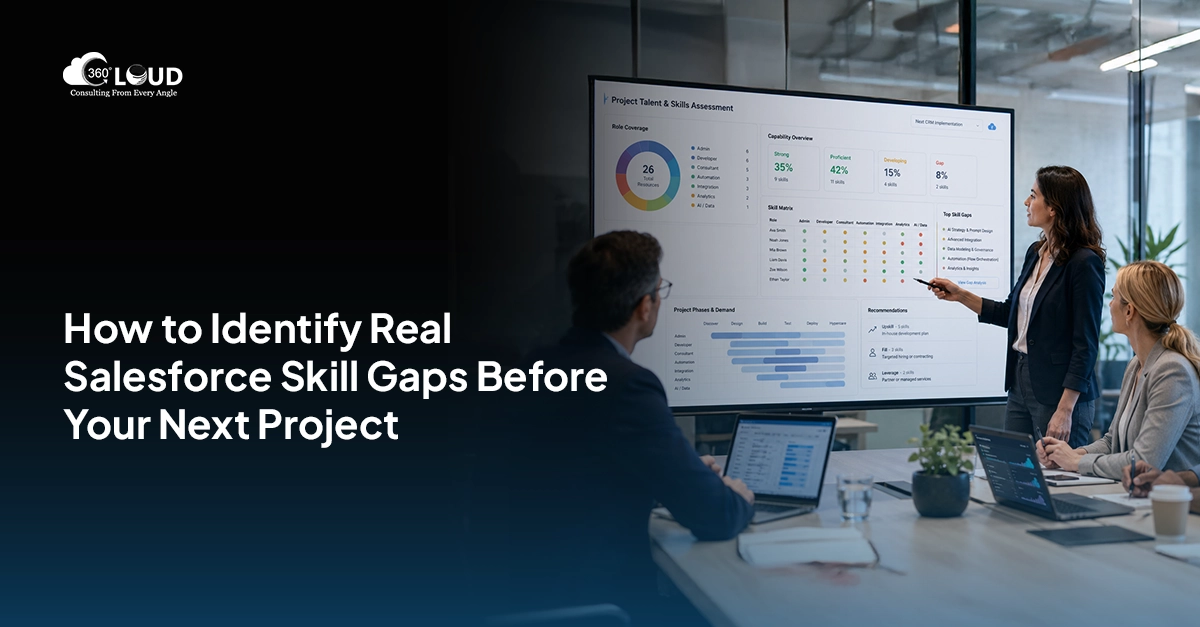
A real Salesforce skill gap shows up in one of three places: specific deliverables that get repeatedly delayed or reworked, specific certifications required for an upcoming implementation that the current team doesn’t hold, or specific workload categories that consistently land on the wrong person. Diagnosing the gap requires looking at delivery history, certification coverage, and workload routing – not asking people what skills they have.
“We have a Salesforce skill gap” is not a proper Salesforce skill gap assessment. It’s a symptom report. Before you decide whether to hire, augment, or retrain – before you can make any of those cases to leadership – you need to know specifically what the gap is, where it’s showing up, and what the cost of leaving it unaddressed is.
This guide gives you the diagnostic process.
Table of Contents
Why Skill Gap Diagnosis Is Usually Wrong
Most organizations assess Salesforce skill gaps by asking the team what they know. That produces inaccurate results for two reasons.
Self-assessment is unreliable for technical depth. A developer who knows some Apex will describe themselves as “an Apex developer.” They won’t volunteer that they’ve never built a complex trigger framework, never handled callout architecture, and would struggle with the integration architecture your new project requires. They believe they’re adequate for most Salesforce work, and they may be right for most work. But your upcoming project isn’t most work.
CRM skills analysis isn’t about what the team knows, it’s about what the upcoming work requires. A team that’s been running Sales Cloud administration doesn’t have a gap until you scope a Health Cloud implementation. The gap is created by the delta between current capability and upcoming requirement, not by absolute skill level.
The right diagnostic process starts with the work, not the team.
Step 1: Identify the Upcoming Requirements
Before assessing the team, document what the next 6–12 months of Salesforce work actually requires.
List every active or planned initiative that touches Salesforce:
- New cloud adoption (Health Cloud, Marketing Cloud, CPQ, FSL, Experience Cloud)
- Integration projects (new ERP connection, third-party API, data warehouse)
- Custom development needs (Apex components, LWC builds, complex automation)
- Architecture decisions (org merge, org split, multi-org strategy, data model redesign)
- Compliance or security requirements (HIPAA implementation, SOX controls, GDPR data model)
For each initiative, identify the specific technical requirements: What certifications does the implementation best practice call for? What Salesforce cloud expertise is essential? What is the complexity level, standard configuration, custom Apex development, complex integration architecture?
That list is your demand profile. The skill gap is whatever the demand profile requires that the current team can’t deliver.
Step 2: Map Current Team Capabilities Against Demand
Now conduct a Salesforce team audit, but against the specific demand profile you’ve documented, not in abstract.
Certification Coverage Check
Start with the objective data: what certifications does the team hold, and do they cover the demand profile?
Create a simple grid:
| Initiative | Required Expertise | Team Member | Current Certification | Gap? |
| Health Cloud build | Health Cloud Accredited Professional | Developer A | Platform Developer I | Yes |
| Revenue Cloud | CPQ Specialist | Developer B | Sales Cloud Consultant | Yes |
| Marketing Cloud integration | Marketing Cloud Developer | — | None | Yes |
| Sales Cloud optimization | Sales Cloud Consultant | Admin A | Sales Cloud Admin | No |
This grid makes the gap visible without interpretation. You’re not assessing the team’s general quality, you’re checking whether the certifications required for specific upcoming work exist in the team.
Certifications are verifiable through the Salesforce Trailhead platform. If you’re not sure what certifications a given initiative typically requires, the Salesforce Partner Trailhead learning paths for each cloud specify the associated certifications.
Delivery History Review
Certifications are a floor, not a ceiling. Cross-reference with delivery history.
For each initiative type on your demand profile, look at what the team has actually delivered in the past 12–18 months:
- Have they delivered a Health Cloud implementation before? If not, they hold the certification but lack deployment experience.
- Have they built CPQ configuration from scratch? Or have they only maintained an existing configuration?
- Have they handled REST/SOAP integrations with external systems? Or is their integration experience limited to native connectors?
Delivery history is the difference between “holds the certification” and “can do the work.” A developer with a Marketing Cloud certification who has never run a Journey Builder implementation is not equivalent to one who has delivered three of them.
Workload Routing Analysis
Look at what actually happens when work arrives:
- When a complex Apex ticket comes in, who picks it up, and is that by design or by default because nobody else can do it?
- When an integration question arises, who gets pulled in, and is that person always the same, suggesting a single-point-of-expertise dependency?
- Are there specific work categories that get pushed to “later” because nobody on the team is confident they can execute them?
Chronic workload routing to one person, and chronic deferral of specific work types, are clearer signals of skill gaps than any self-assessment.
Fill the gap. Keep the project moving.

Step 3: Assess the Cost of the Gap
A skill gap you’ve identified but can’t cost is hard to act on. Finance needs a number, and leadership needs a reason to approve budget.
Project delay cost: If the Health Cloud implementation is delayed 8 weeks because you don’t have the right expertise, and the implementation was expected to generate $X in revenue efficiency or cost reduction, that’s the delay cost. Quantify it.
Technical debt cost: When a developer who isn’t truly qualified for a job delivers something that technically works but is architecturally wrong, incorrect data model, inefficient Apex, improperly configured automation, the rework cost compounds over the following 12–18 months. This is real cost even when it’s hard to see in the moment.
Misallocated resource cost: An admin playing developer because there’s no developer costs you in two directions: the admin is less productive on admin work, and the development work is delivered by someone without the depth to do it correctly. Both directions have cost.
Opportunity cost: The marketing campaign you couldn’t execute because Marketing Cloud wasn’t configured. The customer portal that stayed in backlog because nobody on the team had Experience Cloud depth. These don’t show up as line items, but they’re real.
Step 4: Determine the Right Resolution
Once the gap is diagnosed and costed, the resolution options are clear:
Certify and train the existing team, viable when the gap is a certification the team is close to acquiring, the timeline allows for a 6–12 week training period, and the upcoming requirement isn’t urgent.
Augment with a specialist, the right answer when the gap is in a specialized skill the current team doesn’t have and isn’t positioned to acquire quickly, or when the timeline doesn’t allow for a training path. A 12-week Health Cloud implementation can’t wait for a developer to certify in Health Cloud. Bring in a Health Cloud specialist.
Hire full-time, appropriate when the gap is permanent and the workload is ongoing. If you’re building a Health Cloud practice and you’ll need Health Cloud expertise indefinitely, a full-time hire makes sense at the 18-month-plus horizon.
Your backlog isn’t a capacity problem. It’s a skills problem.

Restructure the workload, occasionally the gap is organizational rather than a skills deficit. Work that’s landing on the wrong person because of how tickets are assigned, not because the right person doesn’t exist on the team.
Most organizations with a real Salesforce skill gap need augmentation as a bridge, immediately addressing the gap for the current requirement while the longer-term resolution (training, hiring) is put in place.
Fill Your Salesforce Gap with the Right Experts
The organizations that handle this well aren’t the ones with the most Salesforce talent. They’re the ones that get ahead of it, before a project kicks off, before a sprint starts slipping, before an admin is quietly doing architect-level work because nobody else can.
A proper Salesforce skill gap assessment isn’t a performance review. It’s a delivery planning tool. When you run it against real upcoming requirements instead of general impressions, it produces a clear answer: here’s what the next project needs, here’s what the current team covers, and here’s where the delta is. That’s the case you bring to leadership. That’s how budget gets approved and timelines get protected.
If your Salesforce team audit has surfaced a gap you don’t have the time or runway to close through training alone, a certification the upcoming project requires, an architecture decision that needs someone who’s made it before, that’s exactly where augmentation earns its place. Not as a permanent fix, but as a bridge that keeps the work moving while the longer-term solution is built.
360 Degree Cloud has a bench of certified Salesforce professionals across every cloud, every specialty, and every engagement length. If your Salesforce capability gap analysis has identified something specific, we can tell you quickly whether we have the right person for it.
Right skill. Right project. Right now.

Categories

Solve It with Salesforce. We’ll Show You How.
AI. Apps. Experts. Everything you need to win with Salesforce under one roof.Frequently Asked Questions
How do I know if we need a Salesforce Architect vs a senior developer?
Architect-level work involves decisions about org structure, data model design, integration architecture, cross-cloud implementation strategy, and technical governance, choices that affect the org for years. Senior developer work executes within an architectural framework. If your project requires someone to make those structural decisions, you need an Architect. If the framework is established and you need execution capacity, a senior developer is the right profile. The tell: are deliverables at risk because of unclear architecture, or because of insufficient execution capacity?
Our Salesforce team says they can handle the upcoming project. How do I verify that?
Ask them to demonstrate it specifically: "Walk me through how you'd approach a Health Cloud implementation with HIPAA requirements, what would you configure, what would you build in Apex, what would you avoid?" An experienced Health Cloud developer gives you a detailed answer. A developer who's read about Health Cloud gives you a general answer. The specificity of the walkthrough is a better signal than their confidence.
What's the difference between a skill gap and a capacity gap?
A skill gap means the work requires expertise that doesn't exist in the current team regardless of how many hours are available. A capacity gap means the expertise exists but there aren't enough people or hours to do the volume of work. Both require external resources, but the profile of what you need is different, specialized expertise vs additional bandwidth in an existing skillset.
How often should we reassess the Salesforce team's skill coverage?
At minimum: at the start of every major planning cycle (quarterly or annually) and before any new cloud or major integration initiative is scoped. The skill gap is a function of the demand profile, and the demand profile changes as the business evolves. A team that was well-covered for last year's roadmap may have gaps against this year's.

About the author
Editorial TeamThe Editorial Team at 360 Degree Cloud brings together seasoned marketers, Salesforce specialists, and technology writers who are passionate about simplifying complex ideas into meaningful insights. With deep expertise in Salesforce solutions, B2B SaaS, and digital transformation, the team curates thought leadership content, industry trends, and practical guides that help businesses navigate growth with clarity and confidence. Every piece we publish reflects our commitment to delivering value, fostering innovation, and connecting readers with the evolving Salesforce ecosystem.
Recent Blogs
 Uncategorized
How to Create a Salesforce Roadmap That Aligns CRM With Business Growth?
Most Salesforce orgs don’t fail on day one. They drift. A new field here, a quick automation there, one more integration because sales asked nicely.…
Read More Uncategorized
Don’t Close 2026 Without This Year-End Salesforce Audit
Picture the first week back after the holidays. Everyone’s still settling in, and nobody’s really working yet. Then a message lands from leadership: they need…
Read More Marketing Cloud
Salesforce Agrees to Acquire Braze: What It Means for Marketing Cloud
Salesforce Acquires Braze for $5.66 Billion – What It Means for Marketing Cloud
Read MoreReady to Make the Most Out of Your Salesforce Instance?
Our Salesforce aces would be happy to help you. Just drop us a line at contact@360degreecloud.com, and we’ll take it from there!
Subscribe to our newsletter
Stay ahead with expert insights, industry trends, and exclusive resources—delivered straight to your inbox.