

How to Create a Salesforce Roadmap That Aligns CRM With Business Growth?
18 Nov 2026
Table of Contents
Most Salesforce orgs don’t fail on day one. They drift. A new field here, a quick automation there, one more integration because sales asked nicely. Two years later, nobody can say why the CRM looks the way it does, or whether it’s helping the business grow.
A Salesforce roadmap fixes that. Here’s how to build one that actually gets used.
Table of Contents
What Is a Salesforce Roadmap, and Why Does It Matter for Business Growth?
A Salesforce roadmap is a plan that shows what you’ll build, fix, or retire in your CRM, in what order, and why. Think of it as the bridge between “we own Salesforce” and “Salesforce moves our numbers.”
Without one, requests pile up and the loudest team wins. With one, every change ties back to a business goal.
It also works as a Salesforce CRM roadmap and a Salesforce strategic roadmap at once. The strategy says where you’re headed. The roadmap says how you get there, one phase at a time. Good Salesforce CRM strategy lives in that second part, because ideas are cheap and sequencing is hard.
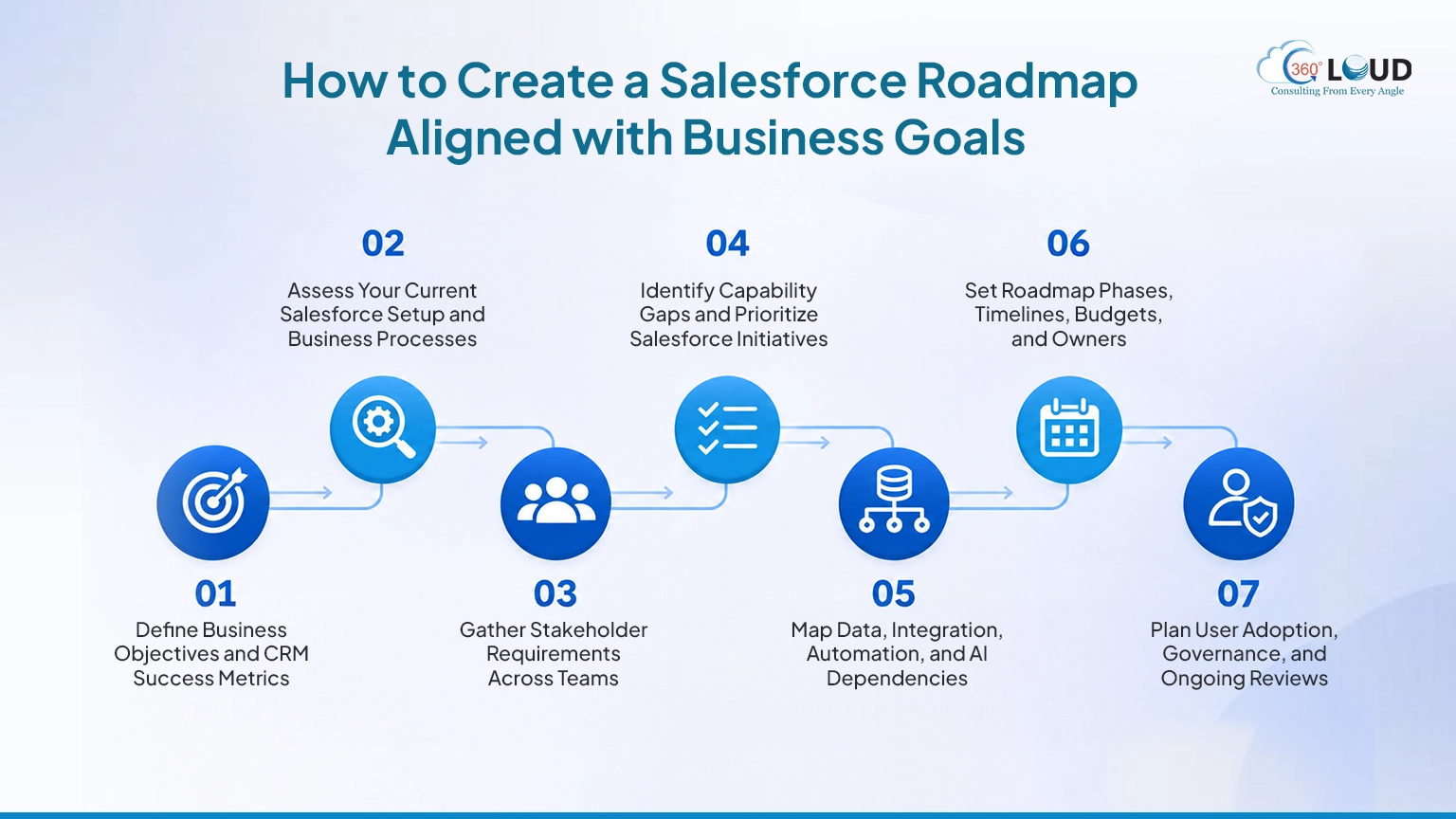
How to Create a Salesforce Roadmap Aligned with Business Goals
Seven steps. None of them is exotic. Skipping any one of them is how roadmaps end up as slide decks nobody opens.
Step 1: Define Business Objectives and CRM Success Metrics
Start outside Salesforce. What does the business need this year? Faster sales cycles, better retention, cleaner forecasting, lower support costs?
Pick three or four goals, then attach a number to each. “Improve pipeline visibility” is a wish. “Cut forecast variance to under 10%” is a target. This is the core of Salesforce business alignment: if a CRM goal can’t point to a business goal, it doesn’t make the list.
Step 2: Assess Your Current Salesforce Setup and Business Processes
Look at what you actually have, not what you think you have. Audit your objects, custom fields, flows, integrations, and licenses. Then watch how people really work.
You’ll find unused automations, duplicate fields, and processes living in spreadsheets because the “official” one is too clunky. (Every org has a shadow process. Every single one.) Write it all down before you plan anything.
Step 3: Gather Stakeholder Requirements Across Teams
Sales will ask for more fields. Service will ask for faster case routing. Marketing wants cleaner lead data. Finance wants to know why the license bill keeps climbing.
Talk to each group directly and ask what slows them down, not what features they want. People describe problems much better than they describe solutions.
Step 4: Identify Capability Gaps and Prioritize Salesforce Initiatives
Now compare where you are against where the goals say you need to be. The gaps become your initiative list. Some will be big, like a CPQ rollout. Some will be small, like fixing lead assignment.
Don’t try to fund everything. Score each item on business impact and effort, and be ruthless. We cover the scoring approach further down.
Step 5: Map Data, Integration, Automation, and AI Dependencies
Here’s where roadmaps quietly break. You can’t run AI-driven forecasting on messy data. You can’t automate a handoff between two systems that don’t talk.
Map what depends on what. Data quality first, then integrations, then automation, then AI. Get that order wrong and you’ll rebuild things twice.
Step 6: Set Roadmap Phases, Timelines, Budgets, and Owners
Group your initiatives into phases of roughly one quarter each. Give every phase a budget range and every initiative a named owner. Not a team. A person.
Build in slack too. Salesforce projects almost never run exactly to plan, and a roadmap with zero buffer is a roadmap that’s already late.
Step 7: Plan User Adoption, Governance, and Ongoing Reviews
A feature nobody uses is just cost. So plan training, change communication, and who approves new requests, right inside the roadmap and not as an afterthought.
Set a review rhythm, too. Quarterly works for most teams. Priorities shift, and your roadmap should shift with them.

What Should a Salesforce Roadmap Include?
Less than you’d think, but each piece has to be real. A roadmap that tries to document everything gets ignored; one that documents the right things gets argued over, which is what you want.
Business Outcomes, Deliverables, and KPIs
For every initiative, state the outcome it’s meant to deliver, what gets built or changed, and the KPI that proves it worked. Three columns. If one is blank, the initiative isn’t ready.
Example: “Reduce lead response time” (outcome), “Automated lead routing” (deliverable), “Median response under 15 minutes” (KPI).
Project Milestones, Dependencies, and Resource Ownership
Add key dates, what each item is waiting on, and who’s responsible. Spell out the dependencies. If the integration with your ERP has to land before the reporting rebuild, say so on paper, where everyone can see it.
Resources matter as much as dates. A plan that assumes your one Salesforce admin is free all quarter isn’t a plan.
Salesforce Roadmap Example: A 12-Month Plan for Business Growth
Every business differs, so treat this Salesforce implementation roadmap as a template to bend, not copy. The three Salesforce implementation phases below suit a mid-sized company that already has Salesforce but isn’t getting full value from it.
Phase 1: Strengthen CRM Data and Core Processes
Months 1 to 4. Clean the foundation. Deduplicate records, standardize fields, tighten validation rules, and simplify the sales and service processes that have grown messy.
It’s not glamorous work. But everything after this depends on it, and skipping it is the single most expensive shortcut in CRM.
Phase 2: Scale Automation and Cross-Team Integrations
Months 5 to 8. Now automate the repetitive stuff: lead routing, approvals, follow-up tasks, renewals. Connect Salesforce to the tools your teams already live in, like ERP, marketing automation, and support platforms.
The goal is simple. Fewer manual handoffs, fewer places for data to go wrong.
Phase 3: Optimize Customer Experiences and AI Readiness
Months 9 to 12. With clean data and connected systems, you can finally do the interesting things. Personalize journeys, build a proper customer 360 view, and pilot AI features like predictive scoring or service assistants.
Pilot, don’t blanket-deploy. Pick one team, measure, then expand.
How to Prioritize Salesforce Roadmap Initiatives for Maximum Business Value
Use a simple two-axis score: business value against effort. High value, low effort goes first. High value, high effort gets planned carefully. Low value, high effort gets cut, no matter who asked for it.
Add two more filters. Does it unblock something else? Does it carry risk if you delay (compliance, a contract renewal, a platform change)? Those can jump the queue even when the raw score looks average.
And say no out loud. A backlog item you never intend to build is just false hope on a spreadsheet.
How to Measure Salesforce Roadmap Success and ROI
Go back to the metrics from Step 1. Measure them before each phase starts, so you have a baseline, then again after it ends.
Track three things. Business results (revenue growth, win rate, retention), operational results (cycle time, hours saved, case resolution speed), and adoption (logins, field completion, dashboard usage). Adoption is the one people forget, and it often explains why the other two stall.
For ROI, compare what you spent on licenses, build work, and training against the gains you can tie to the roadmap. Be honest about what you can’t attribute. A rough number you trust beats a precise one you invented.
Common Salesforce Roadmap Planning Mistakes to Avoid
Planning in a vacuum is the big one. If IT writes the roadmap alone, the business won’t own it.
A few others we see constantly:
- Treating the roadmap as a one-time document instead of a living plan
- Chasing shiny features (hello, AI) before the data can support them
- Skipping adoption planning
- No owners
- Building a 36-month plan with false precision on month 30, when nobody knows what the business will look like by then
Another quiet mistake: ignoring license spend. Roadmaps that add capability without reviewing what you already pay for tend to bloat.
Build a Growth-Focused Salesforce Roadmap With 360 Degree Cloud
You can build this in-house. Plenty of teams do. But if you’re stretched thin, or you’ve inherited an org nobody fully understands, outside eyes help.
360 Degree Cloud is a Salesforce Summit Partner. Our team helps businesses audit their current setup, align it with growth goals, and turn that into a phased plan with real owners and real numbers. No 80-page deck that sits in a folder.

Categories

Solve It with Salesforce. We’ll Show You How.
AI. Apps. Experts. Everything you need to win with Salesforce under one roof.FAQs
Who should own a Salesforce roadmap in an organization?
It depends on the company, but one person needs to be accountable. Usually that’s a Salesforce product owner, CRM lead, or head of revenue operations, working with a steering group from sales, service, marketing, and IT. Shared ownership with no single name on it means nobody owns it.
How often should a Salesforce roadmap be reviewed or updated?
A Salesforce roadmap should be reviewed or updated at least every quarter to ensure it is being followed the right way and any necessary changes can be timely made.
Can you create a Salesforce roadmap for an existing CRM implementation?
Yes, and honestly that’s where most roadmaps start. You begin with an audit of what’s already running, find what’s unused or broken, and plan improvements from there. You don’t need a fresh implementation to benefit. Some of the highest-value roadmap work is cleanup, retiring what doesn’t earn its place and fixing the processes people have been working around for years.
What is the difference between a Salesforce roadmap and a Salesforce project backlog?
That’s really two different time horizons. The roadmap is strategic: outcomes, phases, and timing across months. The backlog is tactical: the detailed list of tasks, stories, and requests the team works through sprint by sprint. Roadmap items feed the backlog, not the other way around.
Do small businesses need a Salesforce roadmap?
A lighter one, yes. Even a one-page plan covering goals, the next three initiatives, and who owns them will keep a small team from over-customizing.
What tools or templates can teams use to visualize a Salesforce roadmap?
Start simple. A spreadsheet, a Gantt-style timeline, or a Kanban board in Jira, Asana, Trello, or Monday.com all work. Some teams use a slide-based timeline for leadership and keep the detail in a project tool. Pick whatever your team will actually open every week. (A beautiful roadmap in a tool nobody checks loses to an ugly one in a tool everybody does.)

About the author
Editorial TeamThe Editorial Team at 360 Degree Cloud brings together seasoned marketers, Salesforce specialists, and technology writers who are passionate about simplifying complex ideas into meaningful insights. With deep expertise in Salesforce solutions, B2B SaaS, and digital transformation, the team curates thought leadership content, industry trends, and practical guides that help businesses navigate growth with clarity and confidence. Every piece we publish reflects our commitment to delivering value, fostering innovation, and connecting readers with the evolving Salesforce ecosystem.
Recent Blogs
 Uncategorized
Don’t Close 2026 Without This Year-End Salesforce Audit
Picture the first week back after the holidays. Everyone’s still settling in, and nobody’s really working yet. Then a message lands from leadership: they need…
Read More Marketing Cloud
Salesforce Agrees to Acquire Braze: What It Means for Marketing Cloud
Salesforce Acquires Braze for $5.66 Billion – What It Means for Marketing Cloud
Read More Salesforce Implementation Services
What is Salesforce Implementation? Everything Decision-Makers Need to Know Before They Start
Most companies don’t buy Salesforce and then wonder what to do with it. They buy Salesforce because something is broken – deals are being tracked…
Read MoreReady to Make the Most Out of Your Salesforce Instance?
Our Salesforce aces would be happy to help you. Just drop us a line at contact@360degreecloud.com, and we’ll take it from there!
Subscribe to our newsletter
Stay ahead with expert insights, industry trends, and exclusive resources—delivered straight to your inbox.