
Salesforce Implementation Failure: Why It Happens, What It Costs, and How to Prevent It
03 Mar 2023
Table of Contents

Depending on which study you read, somewhere between 30 and 70 percent of CRM implementations fail to meet their original objectives. That’s a wide range, but even the conservative end of it should give any decision-maker pause before signing off on a Salesforce project.
Salesforce implementation failure is more common than vendors advertise and more expensive than most teams budget for. The platform is genuinely powerful – but power doesn’t protect you from a bad implementation. In fact, a more capable platform has more ways to be implemented badly.
This article covers why failures happen, what they actually cost when they do, and what separates the implementations that deliver from the ones that get quietly written off as lessons learned.
Table of Contents
What Are the Risks of a Failed Salesforce Implementation?
The risks cluster into three categories, and they compound each other.
Business risk. The most visible damage is to pipeline and revenue operations. When Salesforce doesn’t work as intended, sales teams lose visibility into the pipeline, forecasts become unreliable, and leadership makes decisions based on data nobody trusts. Customer service failures follow when case management breaks down. The business keeps running – just with less information and more friction than before the implementation started.
Technical risk. Data migration errors are the most common and the most expensive. Records that were migrated incorrectly don’t announce themselves; they sit in the system until someone notices that a contact’s history is incomplete, an account is missing its associated opportunities, or an integration is passing bad data downstream. Integration breakdowns are the second major technical risk – when Salesforce doesn’t talk properly to the ERP, the billing system, or the support platform, the result is manual reconciliation work that someone has to do every day. Ungoverned org sprawl – too many custom objects, unmaintained workflows, undocumented automation – turns the org into a system nobody fully understands within two years of go-live.
People risk. User resistance is the failure mode nobody budgets for. When the system doesn’t match how people actually work, they find workarounds – spreadsheets, personal trackers, email threads. Shadow systems emerge. The CRM becomes a reporting obligation rather than a working tool. And once users lose faith in the platform, rebuilding that trust is significantly harder than building it the first time.
The compounding effect: business risk degrades the case for the investment, technical risk makes the system harder to fix, and people risk means fewer users are in the system to notice and report the problems. By the time a failed implementation is formally acknowledged, several of these risks have already materialized.
Top 7 Causes of Salesforce Implementation Failure
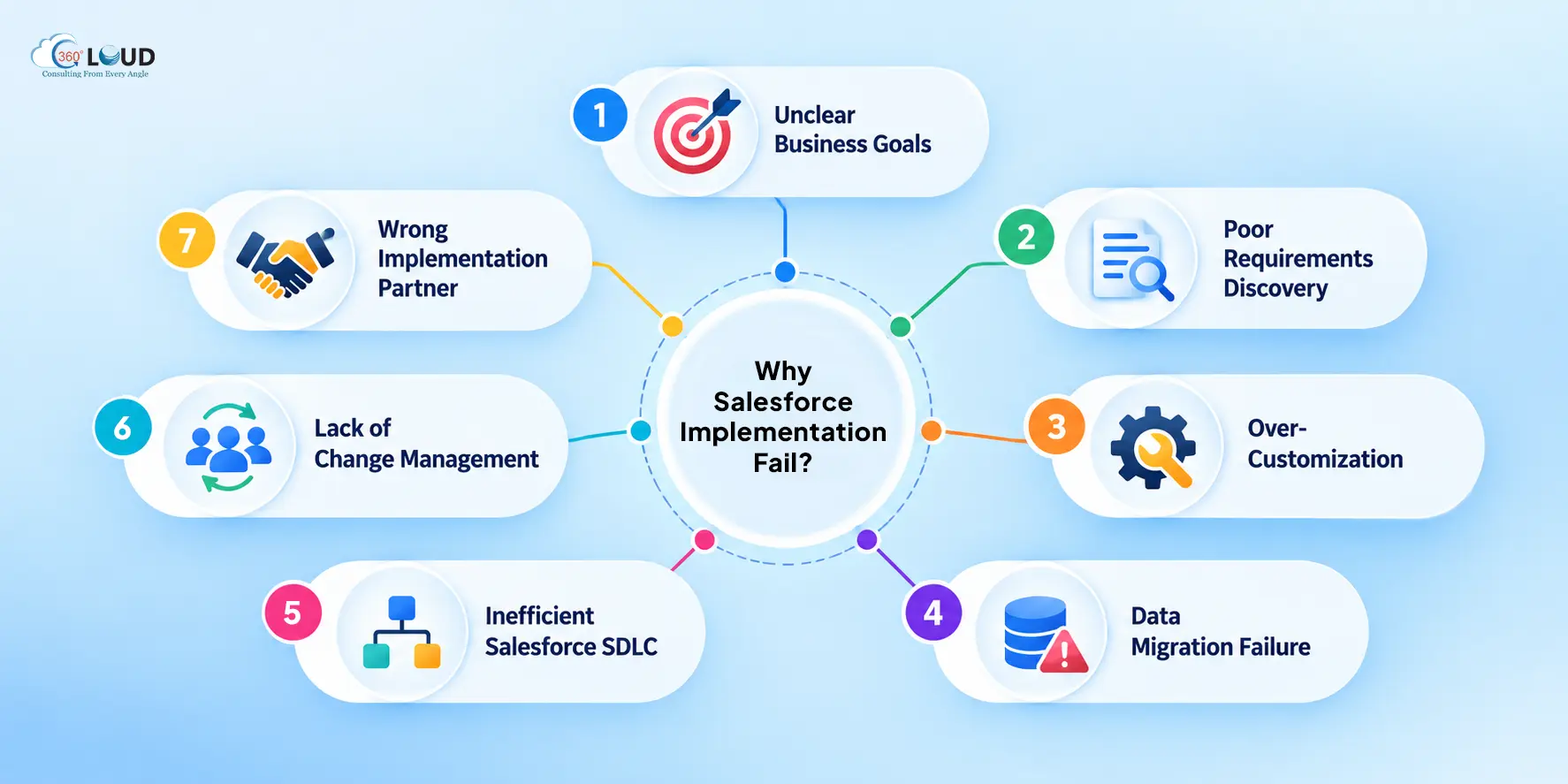
Most failures trace back to one or more of the same causes. None of them are surprising in hindsight, which makes it all the more frustrating that they keep happening.
1. No clear business goals. Implementing technology before defining outcomes is the single most reliable way to end up with a system that doesn’t deliver value. “We need Salesforce” is not a business goal. “We need full pipeline visibility across the sales team within 60 days of go-live” is. The difference matters when it comes to scoping, prioritizing, and measuring success.
2. Poor requirements discovery. Building before understanding what users actually need produces a system that’s technically complete and practically useless. Requirements gathered only from managers – without input from the people doing the work day to day – miss the edge cases, the exceptions, and the workarounds that define how the business actually operates.
3. Over-customization. One of the more counterintuitive failure modes. Teams spend weeks building bespoke solutions for problems Salesforce already solves natively, usually because the partner didn’t push back or didn’t know the native functionality well enough. Over-customized orgs are harder to maintain, harder to upgrade, and more expensive to modify when requirements change – which they always do.
4. Data migration failure. Dirty data doesn’t get cleaner by moving it to a new system. Duplicate records, unmapped fields, inconsistent formats, and contacts tied to inactive accounts all travel with the migration unless someone addresses them beforehand. Most teams underestimate the state of their data until the migration is underway, at which point fixing it costs three times what it would have cost in preparation.
5. Inefficient Salesforce SDLC process. No development/staging/production environment discipline is a more common problem than most implementations admit. Changes tested directly in production, deployments without rollback plans, no version control on metadata – these are the conditions that produce go-live surprises and post-launch instability. A healthy Salesforce SDLC uses sandboxes, change sets or CI/CD pipelines, and a documented deployment process. Many implementations, especially those run by generalist IT firms, skip most of this.
6. No change management. Training that happens once, the week before go-live, is not change management. Users who weren’t consulted during requirements, who don’t understand why the system works the way it does, and who weren’t supported through the transition will find workarounds. Adoption doesn’t happen by accident. It happens because someone planned for it.
7. Wrong implementation partner. Generalist IT firms take on Salesforce projects because they can, not because they specialize in them. A team without deep Salesforce-specific experience makes architecture decisions that are hard to reverse, misses native functionality that would have solved the problem without custom code, and doesn’t know what good looks like when it comes to org governance and deployment practices. The partner decision is the highest-leverage decision in a Salesforce implementation.
Salesforce Implementation Timeline Overruns: Why They Happen
Timeline overruns are the most visible sign that an implementation is in trouble, and they’re rarely caused by one thing.
Scope creep is the most common driver. Requirements expand after the build begins – users see working functionality and realize what they actually need, stakeholders add items that weren’t in the original brief, new integrations get added mid-project. Without a formal change control process, every addition extends the timeline without anyone explicitly deciding to extend it.
Integration delays are the second most common. Third-party systems don’t cooperate as planned. APIs are undocumented, authentication takes longer than expected, the vendor’s sandbox behaves differently from production. Integration work is consistently the hardest part of an implementation to estimate, and consistently the part that’s estimated most optimistically.
Data quality issues turn a planned two-week migration into a six-week remediation. When source data is unclean – and it almost always is – migration takes three times longer than the plan assumed. This isn’t a surprise; it’s a predictable outcome of not auditing the data before the project started.
Stakeholder availability is the quietest timeline killer. Business sponsors who are half-engaged, sign-offs that wait two weeks for a decision that should take two days, UAT participants who can’t clear their calendars – these add days and weeks to a project without ever showing up in a risk register.
Avoiding timeline overruns comes down to three things: fix scope in discovery before the build starts, use agile sprints with defined scope per sprint rather than a single big-bang delivery, and build decision latency into the plan rather than assuming stakeholders will respond in 24 hours.
Salesforce Implementation Cost Overruns: What Drives Them
Cost overruns are usually the downstream consequence of timeline overruns – every month of delay means more consultant fees and more internal resource cost. But cost can blow out even when the timeline holds, and the drivers are worth naming separately.
Rework is expensive in a way that’s hard to see until you’re in it. Rebuilding something that was built incorrectly costs more than building it right the first time: you pay for the original work, the discovery that it’s wrong, the redesign, and the rebuild. When rework is caused by requirements that were poorly captured in discovery, the cost is often disputed between client and partner – which adds legal and relationship cost on top of the technical one.
Data remediation after go-live is significantly more expensive than pre-migration data cleaning. Fixing data quality problems when they’re already live in a production org, affecting active users and live integrations, requires careful, often manual work that can’t be rushed.
Re-training when the first round doesn’t stick adds cost that was rarely in the original budget. When users weren’t consulted during design, training becomes harder – you’re asking them to learn a system that doesn’t match their mental model of how work gets done.
Re-implementation is the most expensive outcome of all. Starting over – new partner, new design, rebuilding on top of or alongside a broken org – routinely costs more than the original implementation. Teams that have gone through a re-implementation report that the second project carries a hidden cost that doesn’t show up in invoices: the internal credibility of the platform takes years to recover.
Prevention comes down to the same principles: scope properly upfront, use a certified Salesforce partner with a track record in your industry, and build a contingency budget – 15 to 20 percent of the total project cost is a reasonable baseline.
Salesforce Implementation Failure in Regulated Industries
Regulated industries carry additional complexity that generic implementation approaches don’t account for, and the cost of getting it wrong is higher than a timeline slip or a rework cycle.
Healthcare implementations must navigate HIPAA compliance, data residency requirements, consent management for patient communications, and in some cases integration with clinical systems that have their own security and interoperability standards. A Salesforce Health Cloud implementation done without a partner who knows HIPAA requirements from direct experience is a liability, not just a technical risk.
Financial services add audit trail requirements, data retention obligations, and compliance with FCA, SEC, or FINRA regulations depending on jurisdiction. Fields that seem like standard CRM data – account ownership, communication history, deal terms – carry regulatory meaning in financial services that changes how they need to be stored, accessed, and reported on.
Government and public sector implementations face data security classifications, procurement processes that add timeline complexity before the project starts, and in some regions, data sovereignty requirements that affect where Salesforce data can be stored and processed.
The common thread across regulated industries: the implementation partner needs specific experience in the relevant compliance framework, not general awareness of it. A partner who has implemented Salesforce Health Cloud in a HIPAA environment has already solved problems your project will encounter. A partner who hasn’t done it before will learn on your timeline and your budget.
Salesforce Implementation Challenges Teams Face Most
Beyond the failure causes and the cost drivers, there are four challenges that come up in almost every implementation – not as catastrophic failures, but as persistent friction that makes the project harder and the outcome less reliable.
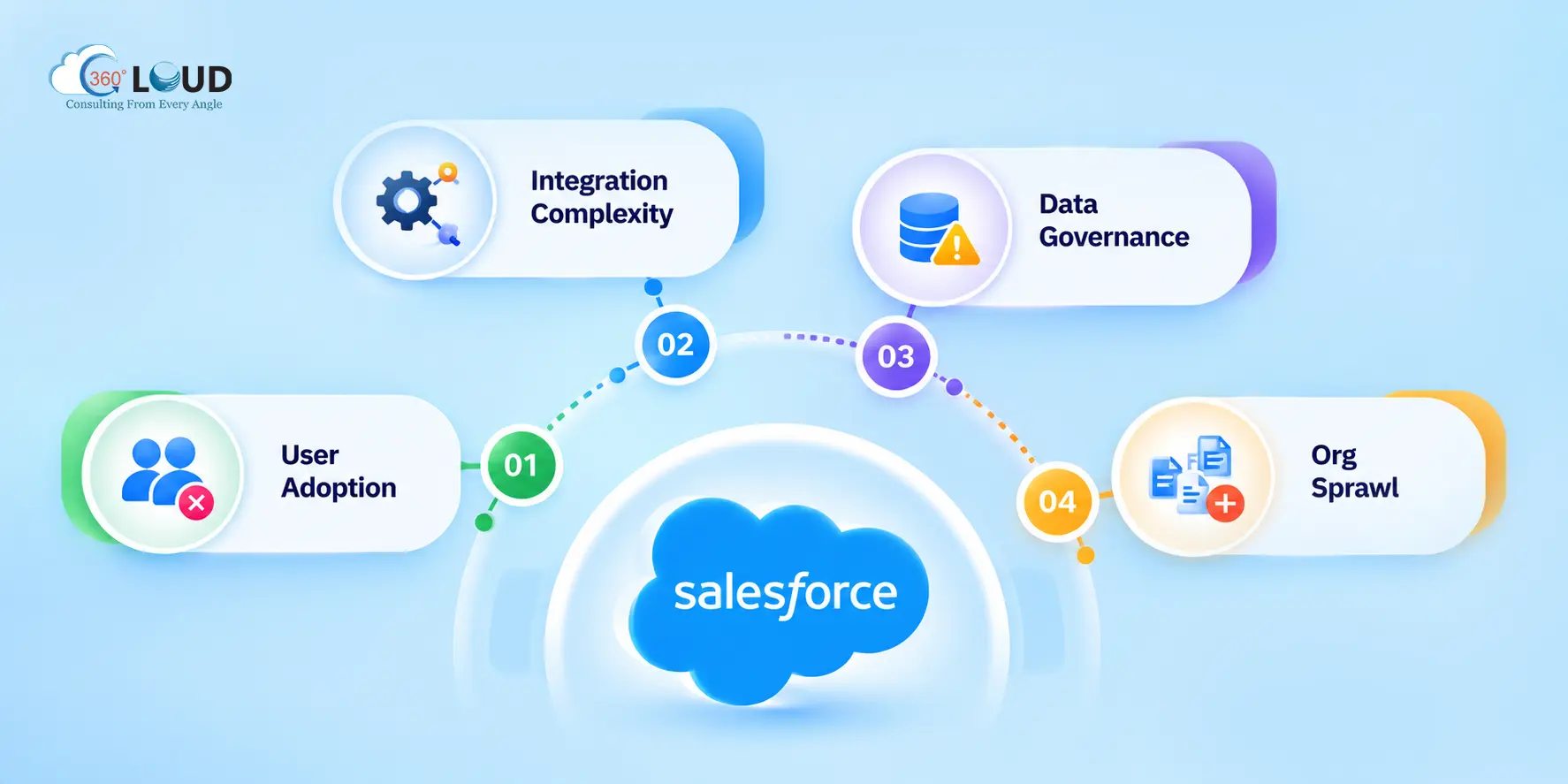
User adoption remains the number one post-go-live failure. It’s the challenge most teams underinvest in and the one that’s hardest to recover from after go-live. The system can be technically perfect and practically unused.
Integration complexity scales with the number of systems in your stack. Every integration is a dependency that can delay the build, break at go-live, or degrade over time as the connected system evolves. More systems equals more risk, and that risk is rarely fully reflected in the original project estimate.
Data governance – or the lack of it. Nobody owns the data quality process. Records get created without required fields, duplicates accumulate, and within six months of go-live the org has data quality problems that mirror the ones in the system you migrated away from. Governance needs to be built into the design, not added as a cleanup project later.
Org sprawl. Unchecked customization – custom objects created for single use cases, automation that duplicates other automation, fields that nobody uses but nobody deletes – makes the org harder to maintain and harder to modify. By the time sprawl becomes a visible problem, the cost of addressing it is significant.
How to Prevent Salesforce Implementation Failure
None of this is inevitable. The implementations that work – that actually deliver the ROI on the license investment – share a recognizable set of practices.
Start with a discovery phase before any build begins. Requirements gathered before a line of configuration is written are cheaper to change than requirements discovered mid-build. A structured discovery phase – two to four weeks depending on scope – produces a requirements document that everyone has agreed to before the clock starts running on build.
Define success metrics in writing before go-live. Login rate above 85 percent. Data completeness above 90 percent on required fields. Pipeline accuracy within a defined tolerance. Whatever the metrics are for your org, write them down and build the reports to track them into the initial implementation. You can’t manage what you haven’t measured.
Use phased releases instead of a big-bang go-live. A single launch date concentrates all the risk at one moment. Phased releases – Sales Cloud first, then Service Cloud, then integrations – let you validate each component before the next one depends on it.
Invest in change management as much as the technical build. This means involving users in requirements, communicating changes before they happen, training in role-specific sessions rather than all-hands walkthroughs, and supporting users through the first weeks after go-live when the questions and frustrations are highest.
Hire a certified Salesforce Summit Partner. The tier matters. Summit Partners have met higher standards for customer success, certifications, and delivery quality. Within that, look for a partner with specific experience in your industry and your clouds.
Build an implementation checklist and review it weekly. Scope, risks, open decisions, data migration status, integration progress, training readiness. A weekly review that covers all of these surfaces problems when they’re still addressable, not at go-live when they’re not.

Categories

Solve It with Salesforce. We’ll Show You How.
AI. Apps. Experts. Everything you need to win with Salesforce under one roof.FAQs
What are the early warning signs that a Salesforce implementation is heading toward failure?
The earliest signs are usually in the requirements process: vague sign-offs, stakeholders who aren't showing up to requirement sessions, or a partner who isn't asking hard questions about edge cases and exceptions. Mid-project warning signs include scope additions without formal change requests, data migration timelines that keep slipping, and UAT that's been pushed back more than once. If the partner is describing problems as "minor" without a written plan for resolving them, that's a warning sign too. The implementations that fail rarely surprise the people close to them - the signals were there, and nobody acted on them.
How long does it take to recover from a failed Salesforce implementation?
It depends on how badly the org is in a state, but most recoveries take six to twelve months. That includes an assessment of what was built, a decision on what to keep versus rebuild, data remediation, and getting users re-engaged with a system they've already lost trust in. The user trust piece is often what takes longest - a technically fixed system still has to overcome the credibility damage from the first go-round.
How much does a Salesforce re-implementation typically cost?
A re-implementation typically costs 1.5 to 2.5 times the original implementation cost. You're paying for the new build plus the cost of unwinding or working around what was built previously, plus data remediation, plus the change management challenge of asking users to engage seriously with a platform they've already experienced as unreliable. The number varies widely with org complexity, but it's rarely cheap.
Can I salvage a failing Salesforce implementation mid-project, or do I need to start over?
Often salvageable, but it depends on where in the project you are and what specifically has gone wrong. Configuration errors caught before go-live are usually fixable without starting over. Data migration problems caught before go-live are remediable, though expensive. Architecture decisions - data model, integration design, security model - that were made incorrectly are harder and sometimes do require a rebuild. Get an independent assessment from a different partner before deciding. A partner assessing their own work has a conflict of interest; a fresh set of eyes will give you a more honest picture.
What percentage of Salesforce implementations go over budget?
Industry estimates put it at 55 to 75 percent, depending on project size and complexity. Larger implementations with more integrations and custom development go over budget more often than smaller, configuration-heavy ones. The most common driver is scope that expanded after the project started without a corresponding budget adjustment - which is a process failure as much as a cost failure.
Who is responsible when a Salesforce implementation fails - the partner or the client?
Both, usually. Partners are responsible for the quality of their technical work, the accuracy of their estimates, and flagging risks they see in the client's requirements or data. Clients are responsible for making stakeholders available, providing accurate information about their data and processes, and making timely decisions when the project needs them. The implementations where responsibility is genuinely disputed are the ones where the contract didn't define it clearly - another reason why a well-structured SOW matters before the project starts.
Is it possible to implement Salesforce successfully without executive sponsorship?
Technically possible for very small, low-complexity implementations. For anything mid-market or above: practically, no. Executive sponsorship drives stakeholder availability, resolves cross-functional disputes about requirements, provides the budget decisions that come up mid-project, and signals to the user base that the platform matters. Implementations without it tend to drift, get deprioritized when other demands compete, and struggle with adoption because users don't see leadership using or championing the system.
What is the most expensive type of Salesforce implementation failure?
Re-implementation - starting over with a broken or abandoned org. But the second most expensive is the slow failure: a system that went live, technically, and then gradually fell into disuse as adoption dropped and workarounds replaced it. This type of failure is often invisible in the financials because the license fees keep getting paid, the system keeps running, and the cost shows up as lost productivity and missed revenue targets rather than a line item. The total cost of a slow failure, measured over two to three years, often exceeds the cost of a visible re-implementation.

About the author
Editorial TeamThe Editorial Team at 360 Degree Cloud brings together seasoned marketers, Salesforce specialists, and technology writers who are passionate about simplifying complex ideas into meaningful insights. With deep expertise in Salesforce solutions, B2B SaaS, and digital transformation, the team curates thought leadership content, industry trends, and practical guides that help businesses navigate growth with clarity and confidence. Every piece we publish reflects our commitment to delivering value, fostering innovation, and connecting readers with the evolving Salesforce ecosystem.
Recent Blogs
 Uncategorized
How to Create a Salesforce Roadmap That Aligns CRM With Business Growth?
Most Salesforce orgs don’t fail on day one. They drift. A new field here, a quick automation there, one more integration because sales asked nicely.…
Read More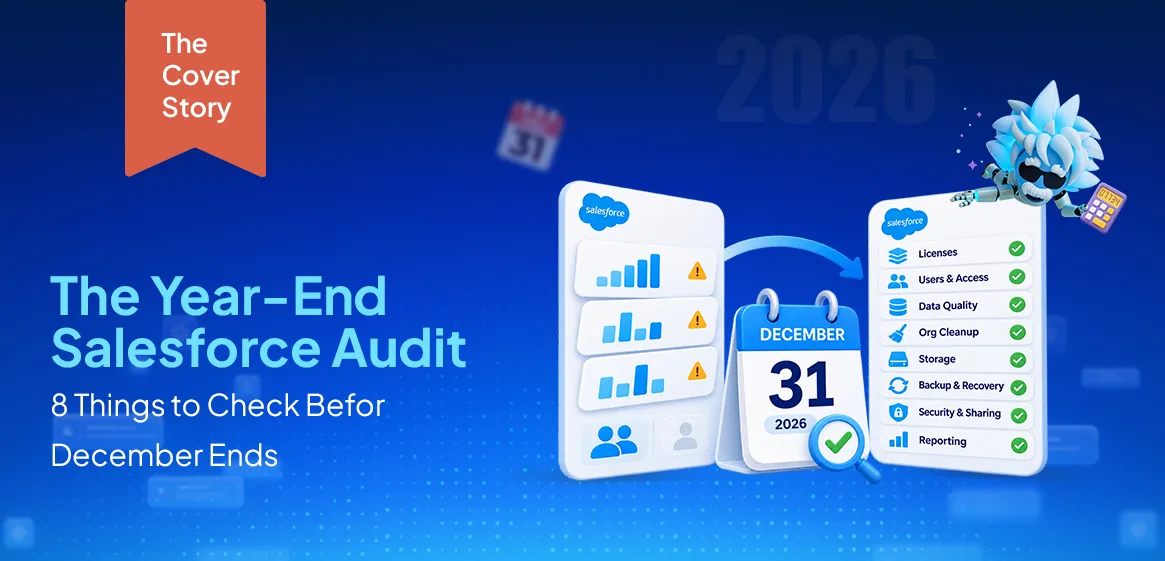 Uncategorized
Don’t Close 2026 Without This Year-End Salesforce Audit
Picture the first week back after the holidays. Everyone’s still settling in, and nobody’s really working yet. Then a message lands from leadership: they need…
Read More Marketing Cloud
Salesforce Agrees to Acquire Braze: What It Means for Marketing Cloud
Salesforce Acquires Braze for $5.66 Billion – What It Means for Marketing Cloud
Read MoreReady to Make the Most Out of Your Salesforce Instance?
Our Salesforce aces would be happy to help you. Just drop us a line at contact@360degreecloud.com, and we’ll take it from there!
Subscribe to our newsletter
Stay ahead with expert insights, industry trends, and exclusive resources—delivered straight to your inbox.