
Who Owns Consent When You’re Running Marketing Cloud Engagement and Next Together?
22 Oct 2026
Table of Contents
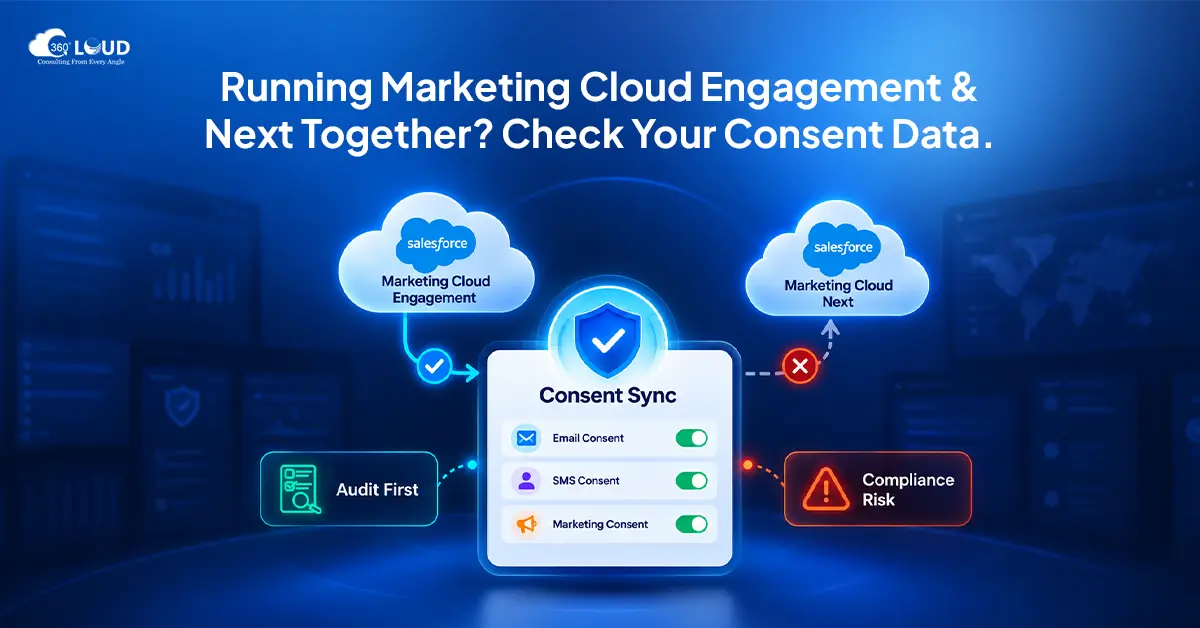
Running Marketing Cloud Account Engagement and Marketing Cloud Next side by side? A lot of Salesforce customers are doing exactly that right now – either by choice or because a migration stalled halfway through and the deadline got pushed. Either way, there’s a consent problem sitting underneath that setup that most marketing teams aren’t thinking about.
Not a configuration issue. A structural one.
The two platforms don’t share a consent layer. That’s the whole problem. And it carries real compliance exposure.
Table of Contents
What the Plus SKUs Actually Encourage You to Do
When Salesforce restructured Marketing Cloud and pushed customers toward the Plus SKUs, the pitch made sense: run Account Engagement for B2B nurture, use Marketing Cloud Next for high-volume transactional sends and cross-channel journeys. One org, two tools, more coverage.
That’s a legitimate use case. But the Plus packaging implicitly assumes you’re managing these as one unified operation – and the platforms weren’t built with a shared consent spine.
Here’s the thing. Account Engagement handles opt-outs at the prospect level inside its own database. Marketing Cloud Next manages communication preferences through its own subscription management and contact data model. And the Data Cloud layer – which is supposed to be the unifying record of truth – doesn’t automatically bridge the two.
So when a contact unsubscribes through an Account Engagement email, that opt-out lives in Engagement. Marketing Cloud Next doesn’t know about it unless someone built a sync to carry the signal over.
Most teams haven’t built that sync.
Where Consent State Diverges, Field by Field
This is where it gets specific – because the divergence isn’t theoretical. It’s field-level, and it’s worth naming exactly what’s happening.
In Account Engagement, the fields that matter:
- Opted Out – the core email opt-out flag; true or false
- Do Not Email – a harder suppression set by admins or import, not editable by prospects
- GDPR Opted In – available on accounts using the GDPR features pack; a separate flag from Opted Out, which trips up a lot of teams
- Prospect custom fields for preference center responses, if you built one
In Marketing Cloud Next, what you’re working with:
- Subscriber status at the All Subscribers level – Active, Unsubscribed, Bounced
- Publication list subscriptions – opt-in at the list level, not contact level
- Contact consent in Data Cloud when it’s in play – a separate object with its own data model
- Preference center responses, stored in their own data extensions
None of these are the same field. None of them sync automatically. Which is not fine – especially when you’re sending from both platforms.
What happens in practice: a contact unsubscribes via a Marketing Cloud Next email, gets flagged as Unsubscribed at the All Subscribers level, and their Account Engagement Opted Out stays false. Then that contact gets enrolled in an Account Engagement nurture sequence – say, through a Salesforce CRM trigger or a list import – and email goes out. They already told you they didn’t want it.
That’s not a worst-case scenario. That’s how the data model works unless you’ve explicitly wired the two systems together.
The Compliance Exposure in Plain Terms
GDPR doesn’t care which platform processed an opt-out. Consent is consent. A data subject exercised their right to withdraw, and you sent them an email anyway because the signal didn’t cross system boundaries. “We didn’t know the opt-out came in through a different platform” won’t hold up in an enforcement conversation.
Under CAN-SPAM, the requirement is ten business days to honor an opt-out. If an unsubscribe processed in Marketing Cloud Next takes days – or never – to reach Account Engagement, that’s a violation. Simple as that.
CASL is stricter still. Express consent must be positive and documented. If you can’t demonstrate that a contact’s opt-in is valid and consistently recorded across both sending systems, the burden falls on you to prove it.
Worth saying: most auditors aren’t interested in your tech stack diagram. They want to see that a stated preference was honored. The fact that the gap was caused by vendor product architecture – not your team’s negligence – doesn’t protect you in an investigation.
The compliance exposure here is real, and it’s sitting quietly in orgs running parallel platforms right now.

The Manual Workaround and How It Fails
Teams that have spotted this problem usually try to solve it one of two ways.
Salesforce Flow or Apex. You build a trigger that watches for changes to Account Engagement’s Opted Out field and pushes a corresponding update to SFMC subscriber status – or vice versa. This works until it doesn’t. The sync is one-directional by default, so you need to manage both directions separately. Flows can fail silently. Apex requires maintenance. And the timing gap between opt-out receipt and sync execution is usually minutes, occasionally longer – which is long enough to get a send out the door in between.
Data Cloud as the consent store. The idea is that contact consent in Data Cloud becomes the master record and both platforms read from it before sending. In theory, clean. In practice, this requires a consent data model that most orgs haven’t built, mapping rules that are genuinely complex to configure, and a real-time suppression check that adds latency to journey sends.
To be fair, neither of these options is wrong. They’re just more fragile than the problem they’re solving. A homegrown sync that fails during a high-volume send period is worse than no sync – because you stop seeing the failure mode while the sends keep going out.
A Governance Model That Survives Parallel Running
If you’re running both platforms – or stuck mid-migration – the governance model needs to be architectural, not operational. Consent enforcement can’t depend on someone remembering to run a sync or check a report.
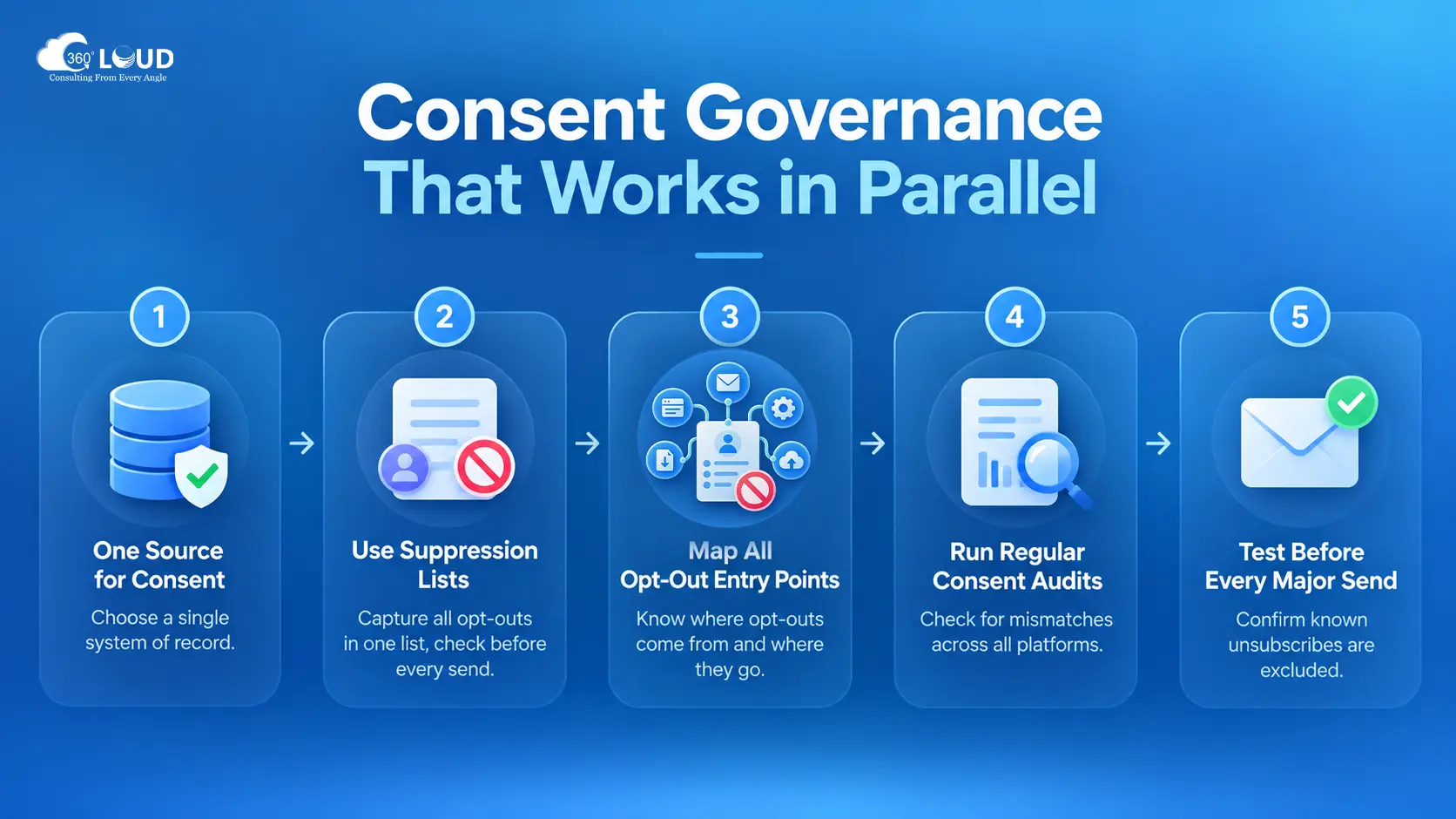
Here’s what actually holds up:
1. Designate one system of record for consent. Pick one. Data Cloud is the right answer if you have it provisioned and staffed. The Salesforce Contact record’s Email Opt Out field is a reasonable fallback if Data Cloud isn’t in play – but it requires every sending platform to check that field before sending, which requires custom configuration in both Engagement and Marketing Cloud Next.
2. Build suppression lists, not sync rules. Rather than trying to keep opt-out flags in sync across systems in real time, maintain a suppression list that’s written to by any system receiving an opt-out – and checked by every system before a send runs. Suppression lists are append-only. They’re simple. They fail loudly rather than silently, which is exactly the failure mode you want.
3. Map every opt-out entry point. Email links, preference center submissions, manual imports, Salesforce record updates, inbound unsubscribe processing. Every one of these writes a consent state somewhere. Document where, and document what happens to that signal next. If you can’t answer “where does this opt-out land and how does it reach both platforms,” the map isn’t done.
4. Set a consent audit cadence. Monthly at minimum. Pull opted-out records from both platforms and the Salesforce CRM. Any contact opted out in one system and active in another is a finding that needs resolution – not a note in a ticket.
5. Test suppressions before every major send. Not just after initial setup. Pull a sample of known unsubscribes and confirm they’re excluded from the send audience in both platforms. This should be pre-send QA, not an afterthought.
That’s the model. Not glamorous. But it’s the one that doesn’t generate audit findings.
What to Audit This Quarter
If you’re running Engagement and Next in parallel and haven’t done a consent audit, this is where to start.
Pull your full opted-out list from Account Engagement. Cross-reference against All Subscribers in Marketing Cloud Next. Any record opted out in Engagement but Active in SFMC is a suppression gap – suppress immediately and document it.
Run the same check in reverse. SFMC Unsubscribed records showing Opted Out = false in Engagement need to be flagged too.
Check your active journeys in Marketing Cloud Next. Any of them pulling entry contacts from Salesforce CRM objects – Leads, Contacts, Campaign Members – without an explicit suppression step? That’s a gap.
Look at Account Engagement automation rules and engagement programs. Any of them using Opted Out = false as an inclusion filter? That’s correct behavior within Engagement, but it won’t catch opt-outs that came in through Marketing Cloud Next and haven’t synced. Most teams don’t catch this one until they’re looking for it.
Document what you find. Not because documentation fixes anything – it doesn’t – but because an undocumented gap you discovered and didn’t act on is significantly harder to defend than one you found, logged, and are actively resolving.

Categories

Solve It with Salesforce. We’ll Show You How.
AI. Apps. Experts. Everything you need to win with Salesforce under one roof.Frequently Asked Questions
Does Salesforce Data Cloud automatically sync consent between Marketing Cloud Account Engagement and Marketing Cloud Next?
No. Data Cloud can serve as a unified consent store - but only if you configure it that way. The sync doesn't happen out of the box. You need to build the consent data model in Data Cloud, map consent attributes from both platforms to it, and configure each platform to check Data Cloud before sending. That's a real implementation project. Not a toggle.
If a contact unsubscribes from a Marketing Cloud Next email, does that opt-out appear in Account Engagement?
It doesn't - not automatically. The unsubscribe sets the subscriber status in SFMC's All Subscribers list and stops there. It won't write to Account Engagement's Opted Out field unless you've built a sync via Salesforce Flow, Apex, or a third-party integration. Without that, the two systems hold separate - and potentially contradictory - consent states for the same contact. In practice, that means a contact can be suppressed in one platform and actively receiving emails from the other.
Is running Engagement and Next in parallel a GDPR violation by default?
Not by default, but the setup creates conditions where a GDPR violation is easy to commit. If a contact exercises their right to withdrawal through one platform and that signal doesn't reach the other, you've failed to honor a data subject request. Whether it constitutes a violation depends on whether a send went out after the opt-out was received. The risk is genuine. The answer is architectural - not a process checklist someone runs manually each week.
What's the fastest way to close the consent gap without a full Data Cloud implementation?
Build a suppression list that both platforms write to and read from. Every opt-out from any channel - email unsubscribe links, preference center submissions, manual imports - appends the contact's email address to a suppression list in Salesforce. Both Marketing Cloud Next and Account Engagement check that list before executing any send or enrolling any contact in an active program. It's not elegant, but it's auditable, it fails loudly, and it doesn't require a Data Cloud contract to implement. Most orgs can stand this up in a sprint.
How often should we audit consent state across both platforms?
Monthly if your send volume is high. Quarterly if volumes are lower and your governance workflow is stable. The audit itself takes a few hours if the right reports exist - pull opted-out records from Engagement, cross-reference All Subscribers in SFMC, flag the discrepancies. The harder question is whether you have a documented process for what happens when you find a gap. Most teams find the discrepancies. Fewer have a written remediation workflow they can show an auditor.
Does Marketing Cloud Next have native preference management that replaces Engagement's preference center?
Marketing Cloud Next has subscription center functionality and supports publication lists. It's not a like-for-like replacement for Account Engagement's preference center - the UX and the underlying data model are different. If you're migrating, this is a decision that needs deliberate planning: where do contacts manage preferences, what gets recorded where, and how does that data flow back to Salesforce. A unified preference center that writes to a shared consent object in Salesforce - rather than to either platform independently - is the cleanest long-term approach. Most teams underscope this during migration planning and deal with the fallout later.
Can Salesforce consent objects handle both Engagement and Next opt-outs natively?
In theory, yes. The Salesforce Individual object and ContactPointTypeConsent were built for exactly this. Both Account Engagement and Marketing Cloud Next can - in principle - read from and write to this model. In practice, the configuration is non-trivial, the documentation is scattered across multiple Salesforce help articles and Trailhead modules, and real-time suppression during sends requires careful testing before you can trust it. If your org is on Enterprise or above and has Salesforce development resources, it's worth building. If not, a well-maintained suppression list covers the most important compliance scenarios at a fraction of the implementation cost. Start there.

About the author
Editorial TeamThe Editorial Team at 360 Degree Cloud brings together seasoned marketers, Salesforce specialists, and technology writers who are passionate about simplifying complex ideas into meaningful insights. With deep expertise in Salesforce solutions, B2B SaaS, and digital transformation, the team curates thought leadership content, industry trends, and practical guides that help businesses navigate growth with clarity and confidence. Every piece we publish reflects our commitment to delivering value, fostering innovation, and connecting readers with the evolving Salesforce ecosystem.
Recent Blogs
 Uncategorized
How to Create a Salesforce Roadmap That Aligns CRM With Business Growth?
Most Salesforce orgs don’t fail on day one. They drift. A new field here, a quick automation there, one more integration because sales asked nicely.…
Read More Uncategorized
Don’t Close 2026 Without This Year-End Salesforce Audit
Picture the first week back after the holidays. Everyone’s still settling in, and nobody’s really working yet. Then a message lands from leadership: they need…
Read More Marketing Cloud
Salesforce Agrees to Acquire Braze: What It Means for Marketing Cloud
Salesforce Acquires Braze for $5.66 Billion – What It Means for Marketing Cloud
Read MoreReady to Make the Most Out of Your Salesforce Instance?
Our Salesforce aces would be happy to help you. Just drop us a line at contact@360degreecloud.com, and we’ll take it from there!
Subscribe to our newsletter
Stay ahead with expert insights, industry trends, and exclusive resources—delivered straight to your inbox.